|
Stevens was born in England on December 24,
1854 to a respectable family of modest means. He received a sound basic
education that ended when he was 14. Three years later he had sufficient
funds to pay for his passage to America. He sought opportunities in the
West and tried his hand at jobs clerking, farming, and ranching. In the
early 1880s in was employed in the Union Pacific rolling mills in
Laramie City, Wyoming Territory. He contributed some material to the
Laramie newspaper, became familiar with the Laramie Bicycle Club, and
knew of their newsworthy bicycle expedition to Yellowstone (Stevens,
Vol. I, 63). He also heard of and possibly met some of the men who had
made unsuccessful efforts to ride across America (Pauly, iv). He was
stimulated to formulated plans to not only ride across America, but to
ride around the world. The idea of continuing the ride after crossing
America probably reflected the broader worldview resulting from his
youth in the hub of the British Empire.
 First of all he needed to learn to ride a bicycle. He purchased a
painted 50" standard Columbia and practiced riding in the parks of San
Francisco. Although still subject to taking headers on his bike he began
his ride from that city on April 22, 1884 and was able to cross the snow
covered Sierra Mountains by following the Central Pacific Railroad
through forty miles of snow sheds. He continued to follow the rail line,
taking advantage of section houses along the route for food and lodging.
In Ogden, Utah Territory the rail line became the Union Pacific and it
led him on to its terminus in Omaha, Nebraska. From this point he
crossed Iowa and reached Chicago on July 4, 1884. After a few days rest
the ride continued on the Great Lakes route that ran from the tip of
Lake Michigan across Indiana to the western end of Lake Erie in the
vicinity of Toledo, Ohio. From that location Stevens followed the
southern shore of Lake Erie to Buffalo where he rode along or near the
Erie Canal across New York State to Albany. The original plan of riding
from Albany to New York City had been changed in route to make Boston
the termination point for his ride across America. The change probably
reflected recognition that Boston was the home of the influential
Columbia bicycle czar, Colonel Pope. First of all he needed to learn to ride a bicycle. He purchased a
painted 50" standard Columbia and practiced riding in the parks of San
Francisco. Although still subject to taking headers on his bike he began
his ride from that city on April 22, 1884 and was able to cross the snow
covered Sierra Mountains by following the Central Pacific Railroad
through forty miles of snow sheds. He continued to follow the rail line,
taking advantage of section houses along the route for food and lodging.
In Ogden, Utah Territory the rail line became the Union Pacific and it
led him on to its terminus in Omaha, Nebraska. From this point he
crossed Iowa and reached Chicago on July 4, 1884. After a few days rest
the ride continued on the Great Lakes route that ran from the tip of
Lake Michigan across Indiana to the western end of Lake Erie in the
vicinity of Toledo, Ohio. From that location Stevens followed the
southern shore of Lake Erie to Buffalo where he rode along or near the
Erie Canal across New York State to Albany. The original plan of riding
from Albany to New York City had been changed in route to make Boston
the termination point for his ride across America. The change probably
reflected recognition that Boston was the home of the influential
Columbia bicycle czar, Colonel Pope.
The Boston Daily Globe of August 5, 1884 reported Stevens' arrival. "He
is of medium height (5'5") and well built (about 140 pounds), he has a
very pleasing manner. He is naturally the fairest of blondes, but so
thoroughly have the sun and the wind done their work that, were it not
for his light moustache, his face would be taken for anything rather
than a white man's. He is an Englishman by birth, and is about 29 years
of age. His attire consisted of a blue flannel shirt, brown
knickerbockers, blue stockings, canvas shoes, and a once white military
helmet hat. A notebook was strapped to the head of his machine. His
clothing showed unmistakable signs of hard usage. His knickerbockers
have been replaced many times."
Stevens used his recollections of the trip and the information recorded
in his notebook to write a wonderful 38,000 word description of his trip
that appeared in the April, May, June, and July 1885 issues of Outing
magazine. His larger two-volume work, Around the World on a Bicycle,
that includes most of the material in these articles, was published
after the completion of his world tour in January 1887. Steven wrote
other books and articles about travels he made without his bike. He
returned to England about 1895, married, led a productive life, and died
in January 1935.
His Outing articles must have stimulated others to undertake a
transcontinental bicycle journey for in 1886 three men undertook the
great ride.
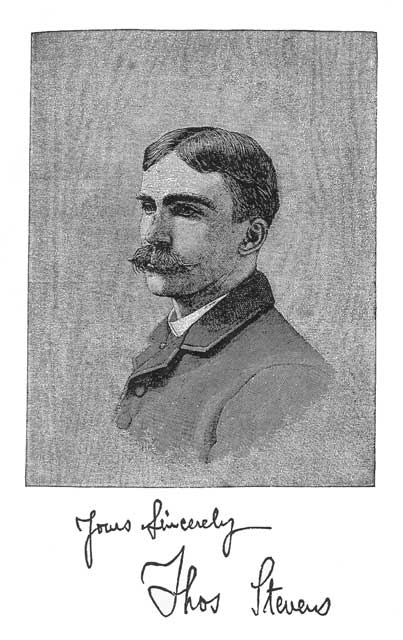
Photo: Thomas Stevens: A
Good Likeness According to Karl Kron. Source: Frontispiece, Vol. II,
Around The World On A Bicycle.
|